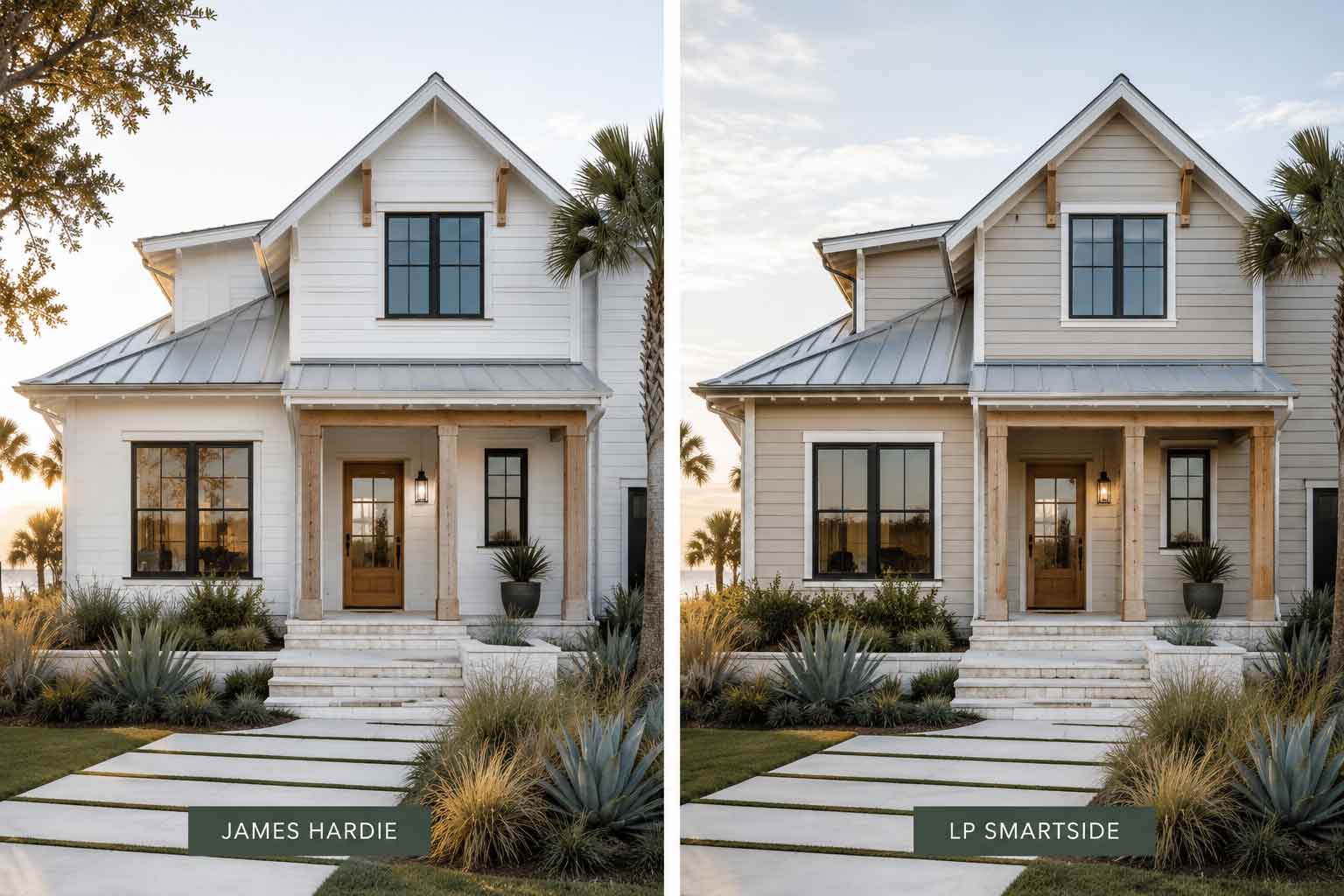
Siding is the single largest exterior surface on your home, and on the Gulf Coast it takes a beating that inland homes never see. Choosing well is worth the time. Below we compare the two products honestly, because both are genuinely good and the better pick depends on your home.
Why siding choice matters more on the Gulf Coast
Salt air, intense UV, driving rain, and the occasional named storm all conspire against an exterior. Materials that perform fine in Atlanta or Nashville can struggle within sight of the water. The closer you are to the Gulf, in Perdido Key, Pensacola Beach, or along Scenic Highway, the more the material and the installation have to be chosen with that exposure in mind. That is exactly the conversation we have on every premium siding installation we take on.
James Hardie fiber cement: how it performs in salt air
James Hardie is fiber cement, a blend of cement, sand, and cellulose fiber. It does not rot, it does not feed mold, insects have no interest in it, and it is noncombustible. In a salt-air environment its biggest advantage is dimensional stability: it barely moves with heat and humidity, which keeps caulk lines and paint intact longer. Hardie also makes products engineered specifically for coastal and high-humidity regions, which is what we typically specify here.
The tradeoffs are weight and installation. Fiber cement is heavy and requires skilled, careful hanging and proper flashing to perform as promised. Done right, a fiber cement siding exterior is one of the most durable and low-maintenance surfaces you can put on a coastal home.
LP SmartSide engineered wood: where it excels
LP SmartSide is engineered wood treated with a zinc borate process that resists rot, fungal decay, and termites. It is significantly lighter than fiber cement, easier to work with, and many homeowners prefer its deeper, more authentic wood grain. It also holds fasteners well, which matters for wind resistance.
The honest caveat is that it is still a wood-based product. It performs beautifully when the finish and sealing are maintained, but it depends on that protective layer staying intact, especially near the water. For homes a little further inland, in Pace, Milton, or Cantonment, it is an outstanding choice.
Head to head: moisture, salt, wind, and impact
On pure moisture and salt resistance, fiber cement has a slight edge because it is not wood-based at all. On weight and workability, engineered wood wins. Both can be installed to meet Florida wind requirements when fastened correctly. Both resist impact far better than vinyl. For most coastal-facing homes we lean toward Hardie; for inland homes where the wood-grain look is the priority, SmartSide is hard to beat.
Cost, maintenance, and lifespan
The two are comparable in price, both well above vinyl and both delivering far more in return. Fiber cement generally asks for less ongoing maintenance, while engineered wood rewards a consistent finish schedule. Properly installed and maintained, either can protect a Gulf Coast home for decades. The deciding factor is rarely the product sheet; it is the quality of the installation and the suitability to your specific exposure.
Which one is right for your home?
There is no universal winner, and any contractor who tells you otherwise is selling, not advising. A home in Perdido Key with constant salt spray has different needs than one in Cordova Park a few miles inland. We walk your home, look at orientation and exposure, talk through the look you want, and recommend the material that fits. Explore our exterior siding services to see how we approach it, or pair new siding with energy-efficient windows for a cohesive exterior.